
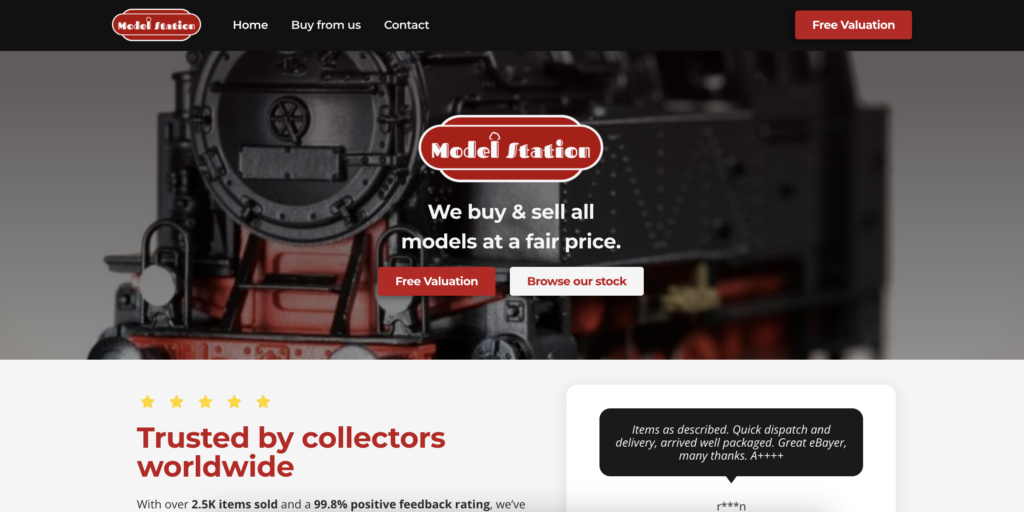
The brief
Model Station already had a proven track record: a successful eBay shop (modelstationofficial, formerly jomak777) trading model trains and railway collectables to a loyal base of hobbyists and collectors. The brief was to take that established business and give it a proper home — a WordPress site that could carry the brand beyond eBay’s four walls, reach a second audience eBay was never built to serve, and put a human face on a business that had, until now, existed entirely inside someone else’s marketplace.
The challenge
Model Station has two very different customers. There’s the hobbyist, who knows exactly what a Hornby Dublo rarity is worth and wants to browse stock. And there’s the family quietly clearing a father’s or grandfather’s collection — someone who doesn’t know what they’ve got, doesn’t want to be sold to, and needs a completely different tone to feel comfortable getting in touch at all. That second group was the real gap: eBay is built for people who already know what they’re buying or selling, not for a nervous first-time enquiry from someone grieving. The site had to speak to both without either audience feeling like an afterthought.
What I built
- A homepage, “Buy from us”, “Sell to us” and Contact page, with reusable components (hero, process block, logo grid, contact form) documented so future build sessions don’t start from scratch.
- A “Sell to us” page built specifically for the inherited-collection audience — soft, empathetic copy, a clear step-by-step process block, and a low-pressure “we’ll come to you” path, deliberately kept in a different register from the punchier collector-facing copy elsewhere on the site.
- Live stock pulled directly from the eBay shop via the Fast eBay Listings plugin, rather than manually maintained product cards — so the site’s “Featured Stock” always reflects what’s actually live on eBay, with zero manual upkeep.
- A custom “Live” badge — a pulsing red dot built from CSS pseudo-elements rather than an image or icon plugin — to make clear at a glance that stock is a live auction, not a fixed-price listing.
- A working contact form wired through GoDaddy’s SMTP relay (
relay-hosting.secureserver.net, port 25, no authentication) after the obvious route — Office 365 direct on port 587 — turned out to be silently blocked by GoDaddy’s own firewall. - Full domain migration from a temporary GoDaddy staging URL to the live Model Station domain, with a pre-migration backup and a full post-migration check of forms, links and SEO metadata across every page.
- A brand system built around Model Station’s red, charcoal and warm grey palette, unifying the logo brands stocked (Hornby, Bachmann, Märklin, Hornby Dublo, Tri-ang, Wrenn, Graham Farish, Dapol) under one consistent look for the first time.
- A parallel content engine on Facebook: real railway footage filmed near Ashley, Cheshire, used as a bridge to pull in railfans before they ever reach the model shop — short, punchy, pop-culture-aware posts rather than straight product marketing.
Problem-solving highlights
- The obvious SMTP setup (Office 365 direct, port 587) failed with no clear error — GoDaddy blocks that port at the firewall level. Rather than reaching for a third-party relay service, traced it back to GoDaddy’s own documented relay path, which needed no credentials at all once pointed at the right host and port.
- The mobile header appeared broken — a middle menu container collapsing to zero width on real devices, despite looking fine in the Elementor preview. After ruling out wrap settings, breakpoints and container widths, and even rebuilding the header from scratch (same fault reappeared), the actual cause turned out to be that the nav menu had no real pages assigned to it yet — Elementor’s editor was silently showing placeholder menu items that don’t exist on a live device. Once the missing pages were built and assigned, the fault disappeared entirely.
- The Fast eBay Listings plugin’s own stylesheet refused to load under any configuration — ruled out both GoDaddy server-level caching and Elementor asset loading as the cause. Rather than keep chasing the plugin’s broken CSS, rebuilt the card styling from scratch by targeting the plugin’s own class names directly, which turned out to be more reliable than depending on a third-party stylesheet at all.
The outcome
The site is now live on its proper domain, and it’s already doing the job it was built for. The side of the business that had genuinely been the bottleneck — people finding Model Station in order to sell to it, not just buy — is now working. Where before the only route in was already knowing to search eBay, the website has given Model Station a real front door, and it’s opened up a steady stream of new sourcing enquiries the business didn’t have access to before.
Why WordPress over Squarespace or Shopify
eBay already handled transactions perfectly well — what Model Station needed wasn’t another storefront, it was a brand presence with room to grow: a place for the inherited-collection story, the Facebook content, and future SEO to live, without being boxed into a template-driven builder’s limitations. WordPress and Elementor gave that flexibility while keeping the build — and the ongoing running costs — firmly in Ian’s own hands.